

More Padel Players, More Injuries: Johan Cruijff Would Say ‘That’s Only Logical’
Here is the complete English translation of the article:
More Padel Players, More Injuries: Johan Cruijff Would Say ‘That’s Only Logical’
The explosive growth of padel also has a flip side. Ophthalmologists are warning of severe eye injuries, while research shows which injuries occur most frequently in padel.
Padel has been growing at a rapid pace in the Netherlands for years. New courts are popping up everywhere, booking at popular times is still a challenge in some locations, and people who had never heard of a bandeja or víbora a few years ago are now on the court multiple times a week.
That is, of course, mostly great news. Padel gets people moving, is social, and is relatively easy to pick up. But its immense popularity also has a less pleasant flip side: doctors are increasingly treating injuries that occur while playing padel. And as Johan Cruijff would have likely summarized it: that’s only logical.
Because when hundreds of thousands of people take up a sport, significantly more hours are simply played. As a result, the absolute number of moments where something can go wrong increases as well. Still, there is good reason to pause a little longer on one specific injury. Dutch ophthalmologists are explicitly warning about eye injuries caused by a padel ball and are advising players to seriously consider eye protection.
From a Growing Sport to a Sport for Almost Everyone
To put the development into perspective: according to the research report Padel in Cijfers 2025 (Padel in Figures 2025) by the KNLTB and EY, no fewer than 876,000 Dutch people stepped onto a padel court at least once in 2025. The Netherlands had 3,523 padel courts across more than 780 providers. This makes padel far from just a small new racket sport.
It is precisely this massive group of players that makes the subject of injuries interesting. Furthermore, it is not exclusively competitive players. Many padel players are recreational enthusiasts who step onto the court after a few lessons, or sometimes without any lessons at all. Padel feels accessible: you can get a rally going relatively quickly and enjoy yourself during your very first match. But being accessible does not automatically mean the body is immediately accustomed to all the short sprints, twists, sudden stops, and overhead shots inherent to the sport.
Known Padel Injuries
Scientific research on padel injuries is still relatively young, but quite a bit is known by now. A 2023 systematic review bundled eight studies involving a total of 2,022 participants. It reported an incidence of approximately 3 injuries per 1,000 training hours and 8 injuries per 1,000 match hours played. The researchers emphasized at the same time that available literature is still limited and methodologically varied.
The elbow emerged as the most frequent injury site in these studies, followed by the knee, shoulder, and lower back. Tendon and muscle injuries were widely reported. That comes as no surprise: anyone playing padel enthusiastically sprints, brakes, pivots, jumps, reaches overhead, and makes many explosive movements in a short time. Poor technique, a lack of warm-up, or suddenly playing much more frequently can raise the strain even further.
A Padel Ball Straight to the Eye
On September 29, 2026, the Dutch Ophthalmological Society (Nederlands Oogheelkundig Gezelschap, NOG) specifically drew attention to eye safety in padel. According to the professional association, ophthalmologists are seeing a clear increase in severe eye injuries resulting from the sport. The news program Hart van Nederland also paid attention to the warning.
The risk is related to a combination of speed, distance, and unpredictability. According to the NOG, a padel ball can reach speeds of over 100 kilometers per hour. Players stand relatively close to one another, and the glass walls are an integral part of gameplay, which can cause the ball to change direction unexpectedly.
A hard impact from a ball to the eye can cause far more than just a black eye. The NOG highlights conditions such as intraocular bleeding, corneal damage, retinal detachment, increased intraocular pressure, lens damage, and in very severe cases, even a rupture of the eyeball. In some instances, vision loss can be permanent.
The Issue Isn't Limited to the Netherlands
The Dutch warning does not stand alone. Swedish researchers examined sport-related eye injuries requiring medical assistance between 2017 and 2021 in the Jönköping region. Of 255 patients with sport-related eye injuries, 20 percent were linked to padel. In 2021, padel was even the primary cause within this study. In virtually all padel cases, the ball was the cause. Most injuries were mild to moderate, but 4 percent suffered severe consequences with a direct risk of long-term complications.
An Italian study published in 2026 surveyed 583 padel players through a voluntary online questionnaire. Sixty participants—10.3 percent—reported having sustained an eye injury during padel at some point; in 92 percent of those cases, a ball was the cause. Six of those sixty players reported having undergone eye surgery. A major caveat applies here: a voluntary online survey is not a representative sample of all padel players. Therefore, one cannot conclude that 10 percent of the overall padel population suffers eye injuries. The study mainly demonstrates that the issue is serious enough to warrant further investigation.
Should We All Be Wearing Safety Glasses Soon?
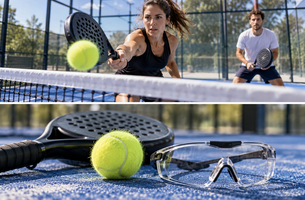
That is naturally the question that arises next. The NOG advises wearing suitable sports goggles, drawing a comparison to squash, where protective eyewear is far more common. For players with only one well-functioning eye, protection is considered especially critical.
There is scientific backing for this from other racket sports as well. A systematic review on eye protection in squash, racquetball, tennis, and badminton concluded that appropriate protective sports glasses can reduce the risk of eye injuries. It is important that these are actual sports-certified protective glasses; standard everyday glasses or contact lenses do not automatically provide the same level of protection.
Don't Panic, Play Mindfully
It would be a shame if reports about injuries led people to believe padel is suddenly an extremely dangerous sport. There is no sound basis for that claim. The massive growth in player numbers simply means that far more hours are being played overall. That alone explains why doctors are encountering more padel-related injuries.
Awareness, however, can help. A proper warm-up, suitable footwear, building up intensity gradually when starting out, paying attention to technique, and listening to physical complaints are logical baseline measures. For eye safety, there is one more factor: look out for each other. Communicate with your partner, stay alert to unpredictable bounces off the glass, and avoid hitting unnecessarily hard shots toward opponents standing close to the net.
Additionally, the NOG advises clubs and facility operators to include eye safety in introductory lessons and clinics, and to inform players about protective sports goggles.
When Should You Seek Medical Help After a Blow?
If you have been struck in the eye by a hard ball or racket and experience pain, blurred vision, flashes of light, blood in the eye, or a feeling as if a curtain is hanging over your field of vision, the NOG advises contacting a doctor or out-of-hours medical service immediately. Prompt assessment can be crucial with eye injuries.
The Flip Side of Massive Success
Ultimately, the discussion around injuries primarily highlights how large padel has become in a short space of time. The Netherlands counts hundreds of thousands of players, thousands of courts, leagues, tournaments, lessons, and recreational players who effortlessly step onto the court multiple times a week.
As a result, topics emerge naturally that were hardly relevant ten years ago: overuse, injury prevention, and now eye protection. More players mean more hours played. More hours played, unfortunately, also mean more moments when something can go wrong.
Johan Cruijff would say: that’s only logical.
But if proper technique, sensible progression, and simple safety measures allow us to prevent a portion of those injuries, that is every bit as logical.
Bronnen
Geraadpleegd voor feiten, cijfers en medische duiding. De bronnen zijn gecontroleerd op 30 september 2026.
Nederlands Oogheelkundig Gezelschap (29-09-2026)
Meer padelspelers, meer oogletsel
https://www.oogheelkunde.org/nieuwsberichten/meer-padelspelers-meer-oogletsel/
Hart van Nederland (30-09-2026)
Ernstig oogletsel door padelbal: artsen pleiten voor veiligheidsbril
https://www.hartvannederland.nl/milieu-gezondheid/zorg/artikelen/ernstig-oogletsel-padelbal-artsen-pleiten-veiligheidsbril
KNLTB / EY (2026)
Padel in Cijfers 2025 – 876.000 spelers, 3.523 banen en 780+ aanbieders
https://www.knltb.nl/nieuws/2026/03/knltb-en-ey-presenteren-tweede-editie-padel-in-cijfers/
Dahmen et al. (2023), BMJ Open Sport & Exercise Medicine
Incidence, prevalence and nature of injuries in padel: a systematic review
https://pubmed.ncbi.nlm.nih.gov/37337550/
Kasiga & Bro (2024), Acta Ophthalmologica
Padel an increasing cause of sport-related eye injuries in Sweden
https://pubmed.ncbi.nlm.nih.gov/37158377/
Aiello et al. (2026), Eye
Ocular injuries in padel: findings from a survey on frequency, risk factors, and perceptions toward protective eyewear
https://pubmed.ncbi.nlm.nih.gov/42010296/
Mazarelo, Winter & Fong (2024), The Physician and Sportsmedicine
A Systematic Review on the Effectiveness of Eyewear in Reducing the Incidence and Severity of Eye Injuries in Racket Sports
https://pubmed.ncbi.nlm.nih.gov/37070274/